France: Applying for our visas
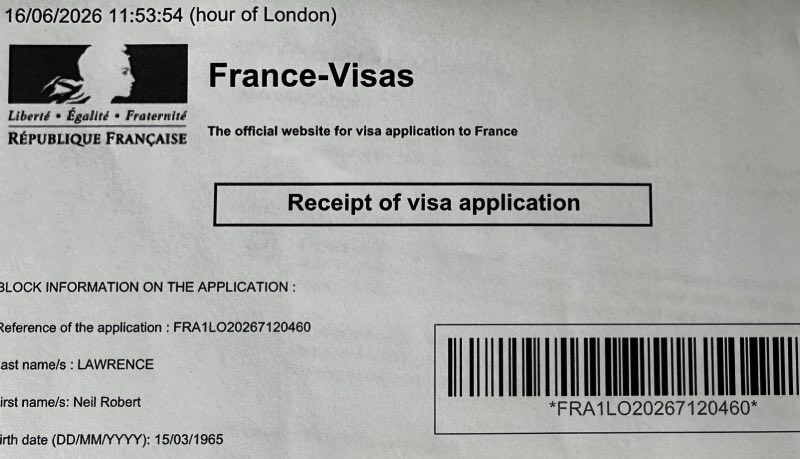
Some friends/colleagues recently have assumed that as we have finished work, we are already in France. No, that clever plan called ‘Brexit’ means that we need to go through a detailed formal visa application process, which we completed this week.
Here’s an overview.
Visa applications
Applying online
We’d held off making our applications until I’d finished working on 29 May, just because you have to make a statement about your situation as part of the application and sign it; I just didn’t feel comfortable stating ‘retired’ until it had actually happened.
Contrary to general belief about French administration, the online application process was pretty good for the first stage. It didn’t hurt that we’d consulted Gemini for some pointers about the precise wording to use at some points, such as the declaration on income.
Creating and submitting the online application means you have to pick a date for when you want the visa to start. To be honest, this was a bit of a wet finger in the air due to progress with the house sale, not having a date for removals to France and not being sure how long the application approval process itself takes, but we went with 15 July as our best shot.
The creation of your application generates an Application ID (one each) which means that you can then apply for an interview (in a separate site; OK, that wasn’t the best online process). Again, we each had to apply for an interview slots, although we were able to join these together so they were at the same date/time.
Oddly, we didn’t have to submit any supporting information with our online application, which contrasts to the amount of evidence that had to be uploaded for our Smart Garant application
Visa interviews
Getting our supporting evidence ready
We’d timed our recent holiday to France to enable us to get back to the UK in time for our interviews. Just.
As we needed our most recent bank statements to take with us to the interviews this gave us a bit of extra time, but also meant we were preparing our paper bundles the day before we left.
The application process sets out what you need to provide, which is:
- a copy of your application form
- your actual passport (plus a copy)
- ID photographs
- a personal statement about your reasons for applying including a promise not to work
- proof of income
- 3 months of bank statements for all current and savings accounts
- proof of accommodation
- proof of 1 year of medical insurance
A lot of this we already had prepared for the Smart Garant application, but recent moves in our finances meant we had to request some additional interim statements from our banks to make sure we could cover off the sums we’d claimed we had in our personal statements.
As we were being interviewed separately, we decided to include joint account statements in both sets of bank statements, plus (being the ex-LocalGov nerds that we are) a short summary of the money side for transparency.
We also threw in an overall evidence summary at the front because if we were in the shoes of the interviewer we’d want life to be a bit easier.
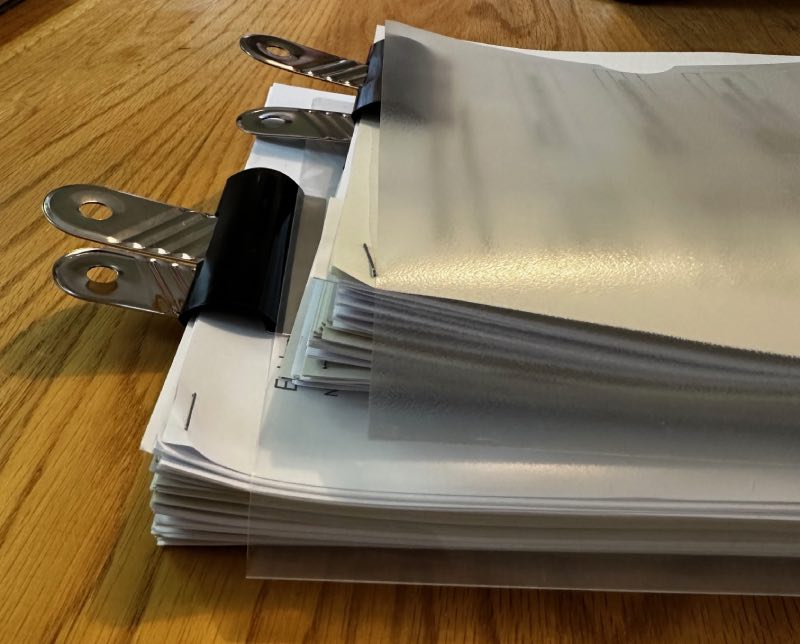
I’m glad that we bought an extra pack of printer paper, as we needed it! The printer ran most of the morning and got perilously close to running out of ink near the end.
As you can see from the photo, it was quite the amount of paper when we’d finished.
Attending our interviews
I’m not sure what I expected from the interview process. In my head it was either going to be a grilling of each of us separately to make sure our stories matched (like getting a marriage licence), or a comfy chat as follows;
SCENE: a plush, carpeted office containing an enormous walnut desk with the French flag pinned behind alongside a large photo of President Macron. Behind the desk sits a large middle-aged man in a suit.
INTERVIEWER: Ah, Monsieur Lawrence. Do come in. Asseyez-vous. A glass of wine, perhaps? Yes?
[Obviously this is spoken with a heavy French accent]
ME: Um, gosh. How nice. Thanks, yes please
INTERVIEWER: (turns serious) Now, why should we let a nasty Rosbif like you into our glorious country? Hmm? You all voted for Brexit, yes?
[At this point the room lighting dims and a spotlight is pointed at me. A large clock ticks noisily in the background, growing louder. Camera zooms in slowly to show sweat beads forming on my forehead]
Obviously it was nothing like this horribly clichéd nightmare. Actually, the best comparison I could come up with was checking in at the airport.
The ‘plush carpeted office’ was actually a built-for purpose visa application centre in Wandsworth. There were lots of people of all nationalities milling around, and a queue which being Brits we joined instantly.
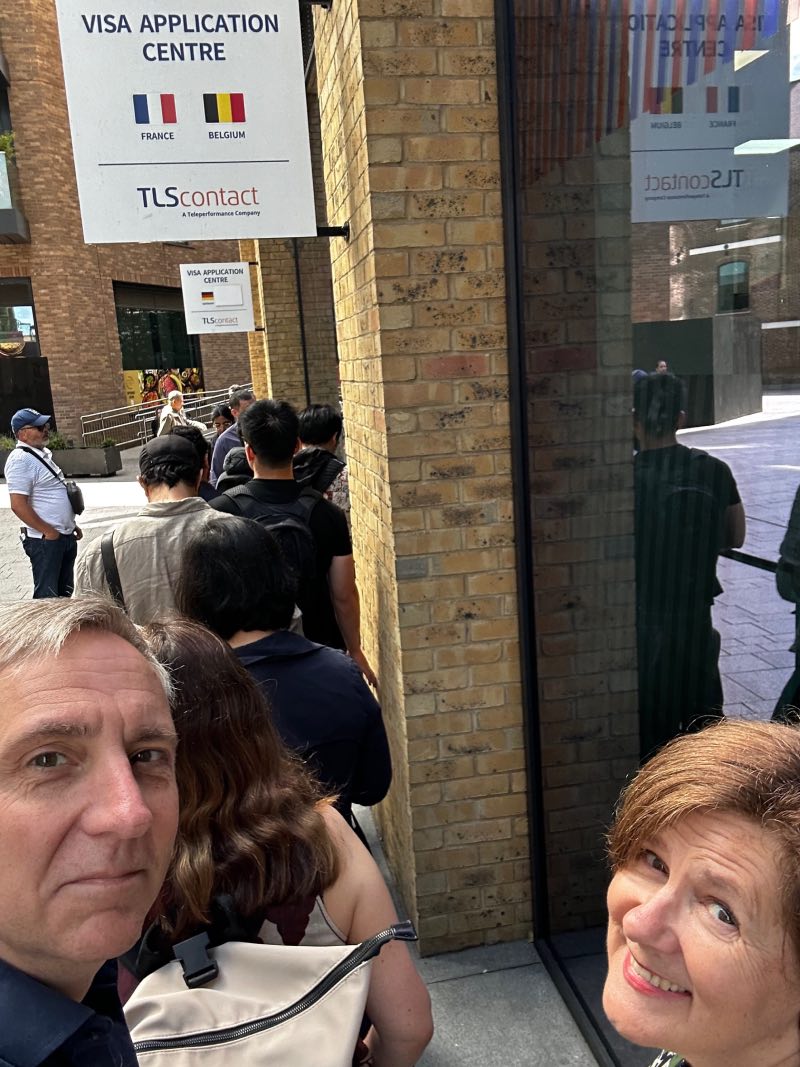
Once we were in I was struck by the volume of people, the signage, the photo booths, various waiting areas, a separate area with someone taking photos and the first queuing section.
Stage 1: Initial filtering
Going back to my airport check-in comparison, we joined a snaking queue (backpacks heaving with our document bundles) until we reached the desk.
As we had separate interview slots I’d figured that meant we had to do everything here separately, but we soon found out we needed to be processed together.
This stage really was to check we had our applications, our passports and proof of accommodation. All of this was entered on a screen with us standing hopefully by, hoping we’d bought the correct flight tickets or something.
Once the person behind the desk finished we were given a ticket with a number (like buying a McDonalds) and told to wait in the next area to be seen.
Stage 2: Document verification
This stage took the longest. We’d been told to expect interviews of around 30 mins, but as there were two of us this took about an hour.
The McDonalds ticket we had started with the prefix ‘L’, and on the announcement board we could see there were 2 others (‘S’ and ‘J’). As long-time ferry terminal waiting aficionados we considered the possibility of these not actually meaning anything as the queues to get on the ferry would be determined by car colour or the mood of the official ‘pointing person’ on the day.
It turns out ‘L’ is for Long Séjour (Long Stay), covering standard long-stay visitor visas (such as retirement or extended tourism). ‘S’ is Student and ‘J’ for Jeunes. You are welcome.
The hour was spent on our feet at a desk going through every document with an overworked interviewer. All the time we’d spent on stapling everything into neat evidence bundles was for nothing as these were all removed.
Although we’d covered why we were applying and a promise not to work in our personal statements we were asked to write each out separately again and sign for them. Really not sure why.
We hit a minor sticking point with my photos as I was far too ugly I wasn’t looking directly at the camera, and my manly shoulders were out of view. Here’s where that person taking photos near the entrance came in. She declined my swimsuit suggestion and went with ‘glasses off only’. This whole step took 2 mins and I had new photos for Stage 3.
We then paid lots of money and waved goodbye to our passports for now.
Rachel asked about processing time and we were told between 4 and 15 days! To be honest this was a complete surprise - I’d been expecting 6 weeks. All our confirmation paperwork now has 15 July 2026 stamped across it. Game on!
Stage 3: Biometrics
Actually this bit was in a carpeted office with a bright light shining at me, but only for the purposes of facial scans, followed by fingerprint scans.
Once this was finished, and my replacement photos were provided, all the documents were placed in a blue cloth pouch for onward transmission.
We were done!
What next?
Soon after leaving Rachel started getting progress emails which will keep us in touch with where we are in the next stage.
So now it looks like our guess at 15 July for the visa start date is a reality we can start arranging removals and (gulp) packing the whole house.